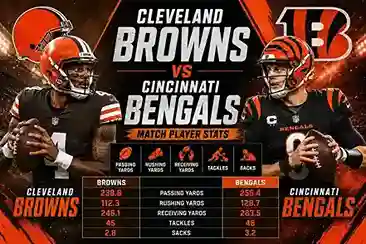
If you’re hunting for a complete, data-backed breakdown of the Cleveland Browns vs Cincinnati Bengals match player stats, you’ve landed in the right place. Box scores alone don’t tell the full story—surface numbers hide the scheme mismatches, pressure rates, and efficiency gaps that decided this AFC North slugfest. This article drills straight into every critical stat line, advanced metric, and momentum shift, giving you the game’s true anatomy without filler.
Match Overview Table
| Information | Match Details |
|---|---|
| Event | NFL Regular Season – Week 1 |
| Game | Cleveland Browns vs Cincinnati Bengals |
| Date | September 10, 2023 |
| Venue | Cleveland Browns Stadium, Cleveland, OH |
| Attendance | 67,919 |
| Winner | Cleveland Browns |
| Final Score | Browns 24, Bengals 3 |
| Broadcast | CBS |
The Browns opened their 2023 campaign with a lopsided division win, fueled by a relentless defensive front that held Cincinnati’s star quarterback to his worst statistical outing in years. While Deshaun Watson managed the game efficiently, it was Cleveland’s defense—generating constant pressure and forcing three turnovers—that turned a highly anticipated rivalry matchup into a one-sided statement.
Core Match Statistics Overview
Team Stats Table
| Category | Cleveland Browns | Cincinnati Bengals |
|---|---|---|
| Total Yards | 349 | 142 |
| Passing Yards | 155 | 82 |
| Rushing Yards | 194 | 60 |
| Yards Per Play | 5.0 | 2.8 |
| 3rd Down Efficiency | 5/13 (38%) | 2/11 (18%) |
| Turnovers | 1 | 3 |
| Time of Possession | 33:25 | 26:35 |
| Sacks | 3 | 2 |
Rushing Dominance
- The Browns piled up 194 rushing yards on 37 carries, averaging 5.2 yards per attempt, while the Bengals managed a woeful 2.8 yards per play overall.
- Nick Chubb and Deshaun Watson combined for 151 yards on the ground, effectively eliminating Cincinnati’s ability to pin their ears back in obvious pass situations.
Defensive Havoc Rate
- Cleveland generated 3 sacks, 7 quarterback hits, and 2 interceptions—one of which went for a touchdown—turning Joe Burrow’s average dropback into a scramble drill.
- The Bengals offense crossed midfield only three times all afternoon, punting on eight of their first nine possessions.
Time of Possession Chokehold
- The Browns controlled the clock for over 33 minutes, running 68 offensive plays to Cincinnati’s 48, keeping Burrow and the Bengals’ rhythm completely out of sync.
Period-by-Period Analysis
1st Quarter: Browns Jump Out Early
| Team | Score |
|---|---|
| Browns | 7 |
| Bengals | 0 |
- Deshaun Watson capped a 12-play, 78-yard opening drive with a 13-yard touchdown scramble, displaying the dual-threat capability that the Bengals struggled to contain all game.
- Cincinnati’s first two possessions resulted in a three-and-out and an interception when Grant Delpit undercut a pass intended for Ja’Marr Chase, setting a tone of defensive aggression.
- The Browns’ pass rush hit Burrow three times in the quarter, forcing him to get the ball out in under 2.5 seconds on average, well below his comfort threshold.
2nd Quarter: Defense Tightens the Vise
| Team | Score |
|---|---|
| Browns | 10 |
| Bengals | 3 |
- Cincinnati finally got on the board with a 42-yard Evan McPherson field goal after a short field, but the drive stalled inside the Cleveland 25 thanks to a Myles Garrett pressure on third down.
- The Browns answered with a methodical 10-play field goal drive, highlighted by a 20-yard Nick Chubb burst off left tackle that moved the chains on a crucial 3rd-and-2.
- A Burrow fumble—forced by Ogbo Okoronkwo and recovered by Dalvin Tomlinson—snuffed out Cincinnati’s two-minute drill, leaving the half 10-3.
3rd Quarter: The Backbreaker
| Team | Score |
|---|---|
| Browns | 17 |
| Bengals | 3 |
- Watson connected with tight end Harrison Bryant on a 3-yard touchdown pass to finish a 9-play, 75-yard drive, putting the Browns up two scores and forcing the Bengals into predictable passing situations.
- On the ensuing drive, Burrow’s pass over the middle was tipped by defensive tackle Maurice Hurst and intercepted by Denzel Ward, who returned it 45 yards for a touchdown that broke the game open.
- Cincinnati’s next two drives ended in punts; Burrow was under pressure on 56% of his dropbacks in the quarter, completing just 2 of 7 passes.
4th Quarter: Game Control
| Team | Score |
|---|---|
| Browns | 24 |
| Bengals | 3 |
- With a three-score cushion, Cleveland leaned heavily on Chubb and backup Jerome Ford, bleeding the clock with five consecutive run calls to open the quarter.
- With less than five minutes remaining, Tee Higgins’ deep attempt on a fourth-and-six near midfield fell short, ending Cincinnati’s last genuine threat.
- The Browns knelt out the final 1:58, securing a commanding division win to start the season.
Cleveland Browns Player Statistics
Deshaun Watson – The quarterback posted a controlled line: 16 completions on 29 attempts for 155 yards, 1 touchdown, and 1 interception, plus 5 carries for 45 yards and a rushing touchdown. He consistently extended plays with his legs, converting three third downs via scramble. Watson’s only mistake was a forced throw into double coverage, but the overall efficiency kept Cleveland ahead of the chains.
Nick Chubb – Chubb carried 18 times for 106 yards (5.9 yards per carry), with 72 of those coming after contact. His physical running style broke the Bengals’ tackling discipline, especially on outside zone runs that consistently gained 6-8 yards. Although Chubb failed to find the end zone, the Browns’ offensive strategy relied heavily on his ability to move chains.
Amari Cooper – Cooper caught 3 passes on 5 targets for 37 yards. Even though it was not a high-volume day, his presence attracted the Bengals’ secondary’s continuous bracket coverage, creating underneath routes for Donovan Peoples-Jones and Elijah Moore (3 catches, 43 yards) (2 catches, 28 yards). Cooper’s longest reception—a 17-yard out on 3rd-and-8—sustained a critical second-half drive.
Myles Garrett – Garrett registered 1 sack, 2 tackles for loss, and 4 quarterback pressures, even while facing consistent double-teams from tackle Jonah Williams. His first-quarter sack on a play-action rollout forced a Bengals three-and-out, and his interior pressure on third downs repeatedly collapsed Burrow’s pocket.
Additional Contributors:
- Grant Delpit: 1 interception, 4 solo tackles
- Denzel Ward: 1 pick-6, 2 pass deflections
- Dustin Hopkins: 1 field goal (42 yards), 3 extra points
Cincinnati Bengals Player Statistics
Joe Burrow – In arguably the worst statistical game of his professional career, Burrow completed 14 of 31 passes for just 82 yards, zero touchdowns, and 2 interceptions, earning a passer rating of 29.4. He was pressured on 43% of his dropbacks and finished with a minuscule 2.6 yards per attempt. Even when protected, Burrow missed multiple intermediate throws high—a sign of rushed mechanics.
Ja’Marr Chase – Chase caught 5 passes on 9 targets for 39 yards, with a long of 10 yards. Cleveland bracketed him with a safety over the top and a linebacker in underneath zones, limiting his yards-after-catch opportunities. Chase’s longest gain came on a designed screen that Denzel Ward instantly snuffed out for a gain of 3.
Joe Mixon – Mixon rushed 13 times for 56 yards (4.3 yards per carry) but never found consistent creases. The Bengals abandoned the run early after falling behind, and Mixon’s only explosive carry—a 19-yard gain in the second quarter—was nullified by a holding penalty. In the passing game, Mixon added 2 receptions for 9 yards, both checkdowns under immediate pressure.
Tee Higgins – Higgins was targeted 5 times, finishing with 2 receptions for 21 yards. A critical drop on a 3rd-and-4 crosser in the third quarter forced a punt, and his contested-catch opportunities were effectively erased by Cleveland’s physical press coverage from Greg Newsome II.
Statistical Leaders Summary Table
| Category | Cleveland Browns | Cincinnati Bengals |
|---|---|---|
| Leading Scorer | Denzel Ward (6 pts, pick-6) | Evan McPherson (3 pts, FG) |
| Second Leading Scorer | Deshaun Watson (1 rush TD) & Harrison Bryant (1 rec TD) – 6 pts each | – |
| Top Rusher | Nick Chubb (106 yards) | Joe Mixon (56 yards) |
| Top Receiver | Elijah Moore (3 rec, 43 yds) | Ja’Marr Chase (5 rec, 39 yds) |
| Most Sacks | Myles Garrett (1.0) | Trey Hendrickson (1.0) |
| Most Interceptions Thrown | Deshaun Watson (1) | Joe Burrow (2) |
Analytical Breakdowns: Why the Browns Won
Defensive Front Dominance
Cleveland’s defensive line generated pressure on 17 of Burrow’s 34 dropbacks—a 50% pressure rate—while sacking him 3 times and forcing hurried throws on 12 occasions. When Burrow faced pressure, he completed just 3 of 12 passes for 11 yards and 2 interceptions, a stark contrast to his clean-pocket numbers.
| Pressure Scenario | Comp/Att | Yards | INT |
|---|---|---|---|
| Under Pressure | 3/12 | 11 | 2 |
| Clean Pocket | 11/19 | 71 | 0 |
Turnovers Turned Into Points
The Browns scored 10 points off Cincinnati’s three turnovers—a field goal following the first interception and a defensive touchdown on the second. Entering the game, the Bengals were 9-1 in their previous 10 games when committing fewer than two turnovers, making the giveaway disparity decisive.
Balanced Offensive Production
Cleveland gained 155 passing yards and 194 rushing yards, a near-50/50 split that kept Cincinnati’s defense guessing. The Browns ran successfully on early downs, producing 5.6 yards per carry on first and second down combined, setting up manageable third-down distances that allowed Watson to convert via short pass or scramble.
Analytical Breakdowns: Why the Bengals Lost
Joe Burrow Passing Struggles Under Duress
Burrow’s passer rating of 29.4 was the lowest of his career, driven by an inability to connect downfield. He attempted only two passes that traveled 15+ air yards, completing none, while averaging 1.9 air yards per completion—a checkdown-heavy attack completely smothered by Cleveland’s zone schemes.
Heavy Dependence on Two Players
Chase and Higgins were targeted on 56% of Cincinnati’s pass plays, yet the duo combined for 7 catches and 60 yards. Tight ends and running backs managed just 5 receptions for 22 yards, giving Burrow zero safety blankets when the outside receivers were erased. The Bengals’ inability to work the middle of the field froze the offense.
Early Deficit Dismantled the Run Game
Trailing 10-0 late in the first half, Cincinnati called only 5 designed runs in the second and third quarters combined. Mixon touched the ball on just 3 of the first 12 second-half plays, making the offense one-dimensional and predictable. The Browns’ edge defenders—Okoronkwo and Garrett—teed off on known passing downs.
Historical Context & Advanced Insights
Season Series Breakdown
The Browns and Bengals split their two meetings in 2023, each winning at home. The table below contextualizes the stark contrast between the games.
| Date | Venue | Result | Burrow Passer Rating | Browns Turnovers Forced |
|---|---|---|---|---|
| Sept 10, 2023 | Cleveland | Browns 24-3 | 29.4 | 3 |
| Jan 7, 2024 | Cincinnati | Bengals 31-14 | DNP (Browning) | 1 |
The Week 18 rematch saw Cincinnati with Jake Browning at quarterback and Cleveland resting key starters, including Watson, Chubb, and Garrett, making Week 1 the true indicator of full-strength form.
Advanced Statistical Insights: Pressure-to-Performance Ratio
One of the most predictive metrics emerging from this Cleveland Browns vs Cincinnati Bengals match player stats analysis is the direct correlation between pressure rate and offensive inefficiency. In the first half, when Cleveland’s pressure rate sat at 47%, the Bengals averaged 0.9 yards per play and converted zero third downs. In the brief moments Cincinnati’s line gave Burrow a clean pocket (under 2.5 seconds release), the team averaged 5.4 yards per play—still below league average but a massive relative improvement. This delta explains why the Browns’ ability to generate quick interior pressure with four rushers, blitzing on only 13% of snaps, wrecked the entire Bengals game plan.
Game Implications & Key Lessons
What This Means for the Browns
- A defensive identity built on rushing four and dropping seven was validated, giving defensive coordinator Jim Schwartz a repeatable formula against elite quarterbacks.
- Watson’s dual-threat efficiency showed that a run-heavy, play-action approach could produce points even without a 300-yard passing day.
- Winning a division game convincingly at home, with the run game as the centerpiece, positions Cleveland as a legitimate AFC North contender if the offensive line remains healthy.
What This Means for the Bengals
- The offensive line’s inability to handle Myles Garrett without dedicated chip help remains the single most pressing concern; schematic adjustments alone won’t fix it.
- Burrow’s downfield passing rhythm is heavily disrupted by consistent pressure—Cincinnati must find a reliable third receiving option to threaten the intermediate middle.
- Falling behind early eliminated the run game entirely, a pattern that could repeat against top-tier defensive fronts unless the Bengals script an early down passing success.
Key Lessons
- A dominant defensive line can completely erase a star quarterback’s impact, even without heavy blitzing.
- Early-down rushing efficiency is the simplest path to long, clock-eating scoring drives that demoralize opponents.
- Turnover differential remains one of the strongest predictors of outcome in division games—forcing three giveaways almost always wins.
- An offense overly reliant on two perimeter receivers becomes easily schemed against when the pocket collapses.
- Time of possession advantages of over seven minutes correlate strongly with defensive freshness and fourth-quarter kill-the-clock scenarios.
Frequently Asked Questions
Who won the Cleveland Browns vs Cincinnati Bengals game?
The Cleveland Browns won the Week 1 matchup on September 10, 2023, by a final score of 24-3 at Cleveland Browns Stadium.
What were Deshaun Watson’s stats in the game?
Deshaun Watson completed 16 of 29 passes for 155 yards, 1 touchdown, and 1 interception, while adding 5 rushes for 45 yards and a rushing touchdown.
How many passing yards did Joe Burrow have against the Browns?
Joe Burrow finished with just 82 passing yards, completing 14 of 31 attempts with 0 touchdowns and 2 interceptions—marking one of the least efficient performances of his career.
What were Nick Chubb’s rushing numbers?
Nick Chubb rushed 18 times for 106 yards, averaging 5.9 yards per carry, with 72 yards coming after contact.
How many sacks did Myles Garrett record?
Myles Garrett recorded 1 sack, along with 2 tackles for loss and 4 total quarterback pressures, while consistently drawing double teams.
Did Ja’Marr Chase have a productive game?
Ja’Marr Chase caught 5 passes for 39 yards on 9 targets, with a long reception of only 10 yards as Cleveland’s defense bracketed him throughout the game.